My Child Won't Go to School: Signs, Reasons, and What to Do Next
Article at a Glance
- School refusal is common, but not the same as skipping school. Between 1 and 5 percent of school-age kids go through it, and it's usually driven by anxiety or distress, not defiance.
- It shows up in more than just missed days. Morning stomachaches, tears at the door, late arrivals, early pickups, and frequent trips to the nurse can all be part of the pattern.
- The longer a child stays home, the tougher it is to return. Avoidance lowers anxiety for a day but grows it for a month, so acting early matters.
- Your first moves are simple: listen, take notes, and call the school. You don't need to know the cause before you ask for help.
- Be warm and firm at the same time. Validate the fear, keep the expectation that school will happen, and break the return into small, doable steps.
- Treatment works. Cognitive behavioral therapy with gradual exposure is the preferred method, while in-home support can assist with the most challenging mornings.
- Know your rights in Pennsylvania and the rules you must follow. Understand how truancy is defined and how to request an evaluation in writing.
It's 7:15 in the morning, and my child won’t go to school!
The bus will arrive in twenty minutes, and your child is curled up under the covers, saying that their stomach hurts. Yesterday it was a headache. The day before, it was crying at the front door.
Later, once the house is finally quiet, you open up Reddit and search for "my child won't go to school," hoping someone has an answer. If this story sounds like what’s happening at your home, I'm glad we’re connecting through this article. You're not alone, and you're not a bad parent.
When a child objects or refuses to go to school, there's almost always a reason behind it. It may be anxiety. Other times it might be fear or worry. It might be a class that feels overwhelming or a test that seems impossible to pass. Over the past 30 years of working with families in the Pittsburgh area, I've witnessed numerous instances of school refusal being successfully addressed. It takes a plan, patience, and a team. Let's build yours.
What Does It Mean When a Child Won't Go to School?
First, let's sort out the words you'll hear. Teachers, counselors, and doctors may call this school refusal or school avoidance. Some professionals, especially in the UK, call it Emotionally Based School Avoidance. Regardless of the name, they all point to the same issue: a child is having real trouble getting to school or staying there because school has begun to feel emotionally overwhelming.
And it isn't always a full day missed. Late arrivals, early pickups, hours in the nurse's office, or a meltdown in the parking lot are all symptoms of the same problem.
School refusal also differs from truancy. A truant teenager usually skips school to do something more appealing, often without telling anyone. This is a behavioral and obedience issue. A child with school refusal typically wants to be home with you and makes no secret of how upset they are.
I can't stress this difference enough. Every week, I see kids struggling with school refusal, from preschoolers as young as 3 or 4 all the way up to a high schooler I met with just last week. For these kids, the refusal is rooted in anxiety. Overwhelmed, a child misses a day here and there, falls behind, and then it snowballs.
Honestly, my heart goes out to these children and teens. They're facing real anxiety, feeling overwhelmed, and often feeling trapped by their own emotions.
Rather than a diagnosis, school refusal describes a behavior. With that in mind, our job is to figure out what's driving it.
Signs Your Child Is Struggling
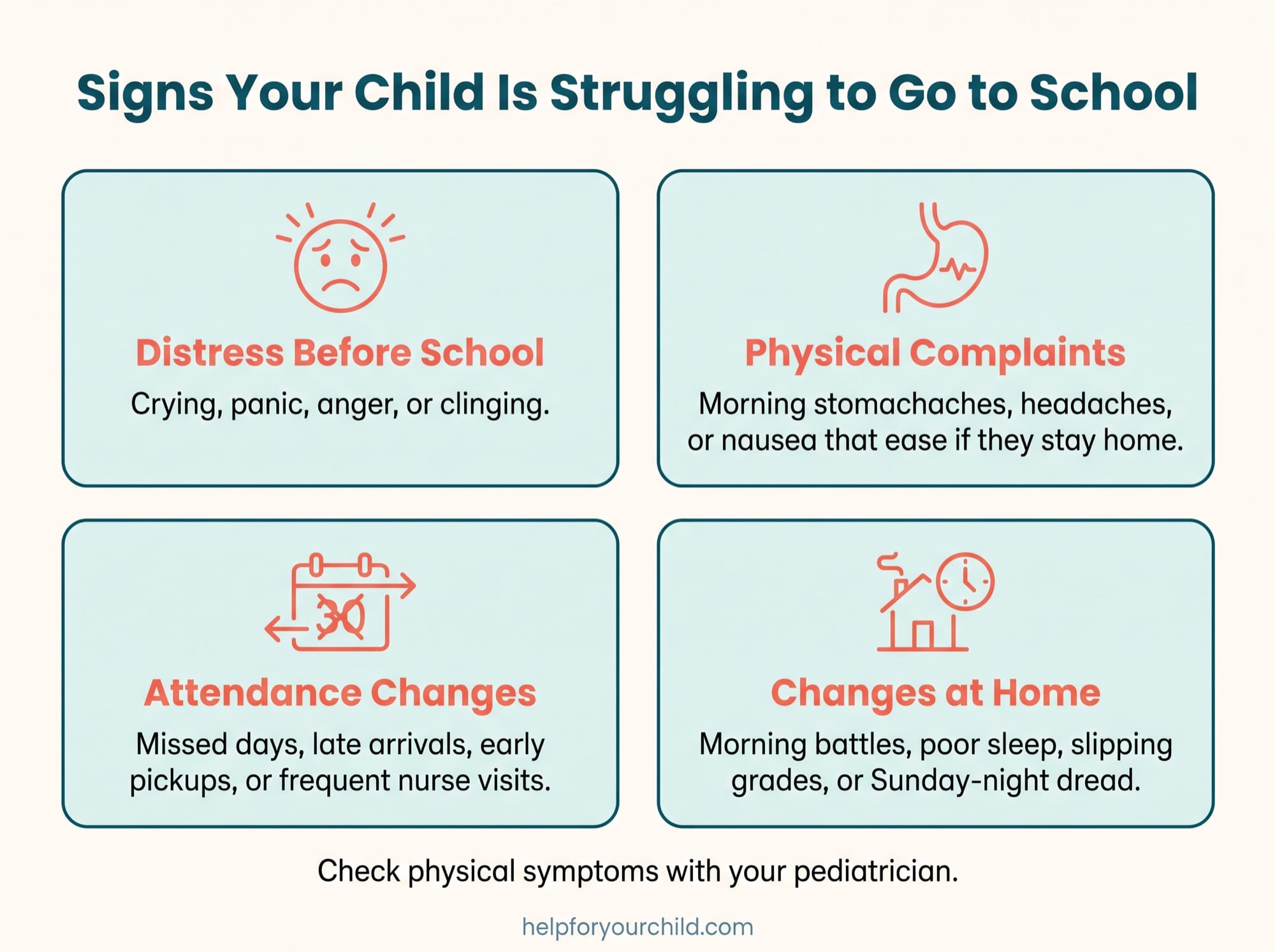
Some kids will tell you exactly what's wrong. Most don't. Instead, the struggle tends to show up in patterns like these:
- Distress before school. Children may experience distress in various forms, including crying, panic, anger, clinging, or even a full-blown standoff at the door. For many kids, the dread starts the night before.
- Physical complaints. Stomachaches, headaches, nausea, and even vomiting. These often show up in the morning and ease if your child stays home. Still, check with your pediatrician before assuming it's anxiety. Bodies deserve a look, too.
- Attendance changes. Missed days, repeated lateness, early pickups, and frequent nurse visits all contribute to chronic absenteeism. Missing 10 percent of school days for any reason, about 18 days in a typical year, counts as chronic absence, and catching up becomes much harder from there.
- Changes at home. Trouble sleeping, battles every morning, slipping grades, or a happy child all weekend and miserable by Sunday night.
Why Won't My Child Go to School?
It's tempting to look for a single cause. Usually, it's a mix of things. Here's what I see most often in my practice:
- Anxiety. This is the big one. It might be separation anxiety (worry about leaving you), social anxiety (fear of being judged), or more generalized anxiety.
- Bullying or peer trouble. A rough lunch table, a group chat gone wrong, or not feeling safe. Here's what parents can do about bullying.
- Learning struggles. Daily challenges with reading, math, or focus can make school feel like constant failure. These feelings can be especially challenging for children with ADHD or learning difficulties.
- Big transitions. Starting kindergarten, moving up to middle school, switching schools, or returning after an illness or a long break.
- Environmental concerns. Loud cafeterias, crowded hallways, and sensory overload can all be contributing factors.
- Stress at home. A move, a new sibling, an illness in the family, or a separation can all be stressors at home.
Key Point: regardless of what started it, avoidance keeps it going.
Staying home brings instant relief, and the brain remembers it. However, when tomorrow comes, the worry is bigger, and going back is even harder. The very thing that calms your child today makes school scarier tomorrow.
School Refusal at Different Ages: What to Expect
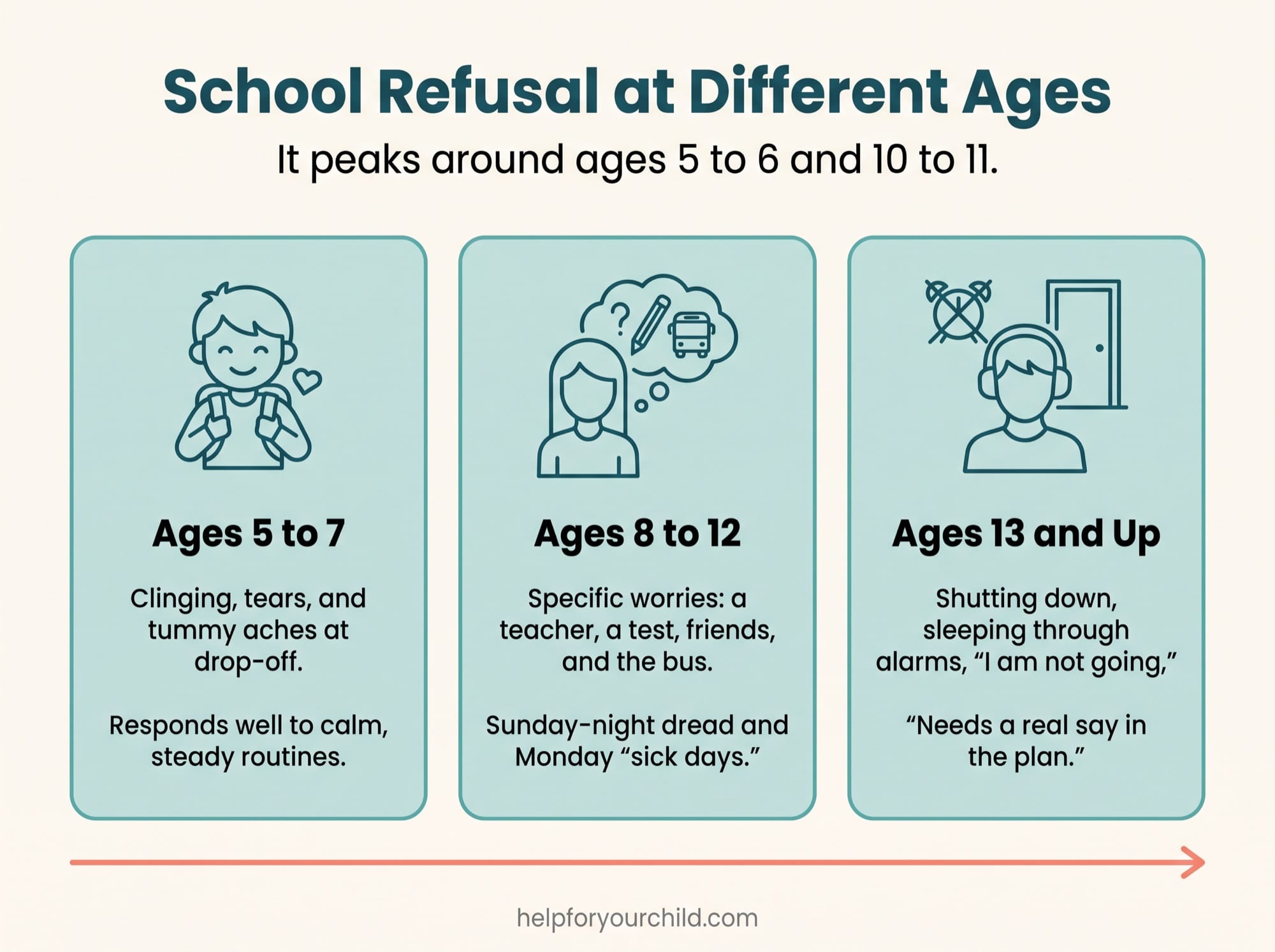
School refusal can happen at any age, but it peaks around ages 5 to 6 and 10 to 11, according to American Family Physician and a 2024 research review. Those ages line up with big transitions: starting school and heading toward middle school.
Young Children (Ages 5 to 7)
If your 6-year-old refuses to go to school, you'll probably see clinging, tears, drop-off tantrums, and plenty of tummy aches. Separation worry is the usual driver. The good news? Little ones often respond quickly to a calm routine and a confident handoff.
Tweens (Ages 8 to 12)
Older kids have words for their worries. If your 11-year-old is refusing to go to school, listen for specifics: a teacher, a test, a friend group, or the bus. Sunday-night dread and Monday "sick days" are common at this age.
Teens (Ages 13 and Up)
With teenagers, refusal can look like shutting down, sleeping through alarms, or a flat "I'm not going." Depression, social anxiety, sleep, and screen time all significantly contribute to this issue. Involving teens in the plan is essential, so include them in the discussion.
What to Do When Your Child Refuses to Go to School
There's no magic formula, but there is a solid process. It begins by starting early.
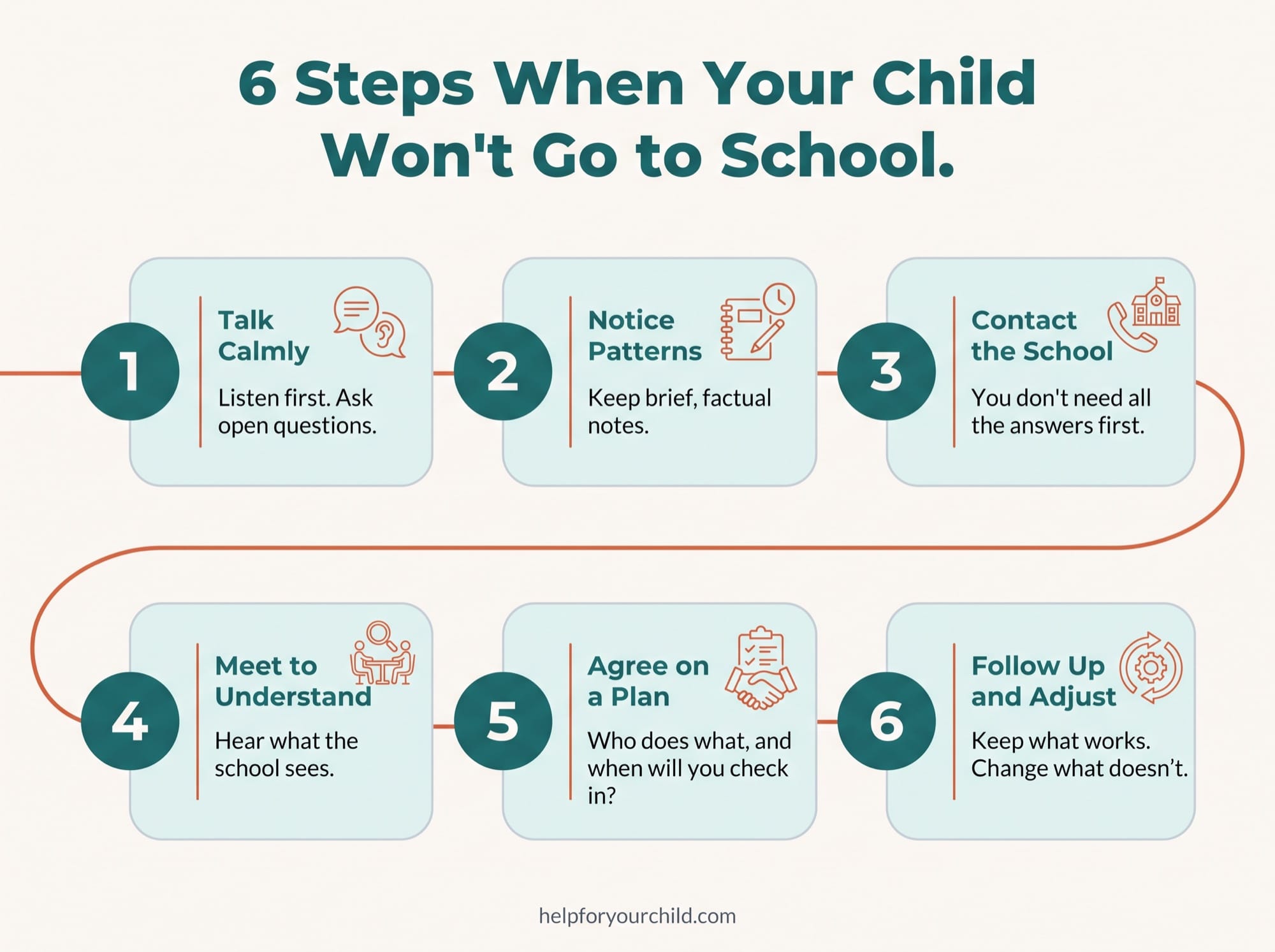
Step 1: Talk With Your Child, Calmly
Pick a quiet moment, not 7:40 a.m. with the bus idling outside. Then lead with empathy:
"I know school has felt really hard lately. I'm not mad at you. I want to understand what's going on so we can figure out what might help."
Next, ask open questions, like "What part of the day feels hardest?" Listen more than you talk. If talking is difficult, let your kiddo write it down instead.
Step 2: Notice Patterns and Keep Notes
For a week or two, jot down when the distress starts, what your child says, any physical complaints, and what actually helps. Keep it factual. For example: "On Monday, the student was upset while getting dressed and mentioned that the cafeteria is too loud. Arrived 20 minutes late." Those notes are invaluable when communicating with the school or a therapist.
Step 3: Contact the School
You don't have to have everything figured out beforehand. Ask for a private conversation with your child's teacher and, if possible, the school counselor. Here's an email you can adapt:
Subject: Request to discuss support for [Child's name]'s attendance
Hello [Teacher's name],
[Child's name] has been having a difficult time getting to school or staying there. Over the past [time], I've noticed [brief examples, such as "several late mornings and a lot of distress before leaving home"].
I'm not sure yet what's behind it, and I'd like to work with you to understand what school is like for [Child's name] and what might help. Could we arrange a time to talk and include [the school counselor] if possible?
Thank you.
[Your name]
If your child has mentioned bullying, safety, or a health issue, say so and ask what the school will do about it.
Step 4: Meet to Understand, Not to Win
Ask what staff have noticed, which parts of the day seem hardest, and who your child can turn to when overwhelmed. Kids often act differently at school than at home, so both views matter.
Step 5: Agree on a Specific Plan
Before you leave, settle who does what and when you'll check in. Supports might include a staff member who greets your child, a calm-down spot, or help with a tough transition. Keep it realistic. A gradual return beats a dramatic one that falls apart by Wednesday.
Step 6: Follow Up and Adjust
After a week or two, compare notes with the school. Keep what's working and tweak the rest. If things aren't improving, it's time to seek professional help.
The Morning Of: Warm, Calm, and Firm
But what about 7:15 tomorrow? My approach hasn't changed much in 30 years: rely on the carrot, not the stick.
- Validate, then expect. "I know your stomach feels tight. And you're going to school today. We'll handle it together." Both things can be true.
- Keep mornings predictable. Pack the bag and lay out clothes the night before. Same wake-up, same routine. (More ideas: easier school mornings.)
- Reward effort. Praise every step and use small incentives. A partial day still counts as a win.
- Make the home boring. If your child stays home, no video games, TV, or enjoyable outings during school hours. Home shouldn't feel like a day off.
- Try the 3-3-3 rule. Have your child name three things they can see, three things they can hear, and then move three parts of their body. Practice it on calm days so it's ready on hard ones.
With younger kids, "firm" can mean walking them into the building yourself, ideally with both parents or another trusted adult working as a team. Some parents have even let a child arrive in pajamas and change in the nurse's office. The message stays calm and simple: you're going to school. Once kids see the fuss doesn't change the outcome, resistance usually eases. With older kids, that isn't realistic, so professional support comes in.
Working With Your Child's School
Sometimes schoolwork adds to the pressure, too. When a child struggles with reading, for example, keeping up gets hard. They fall behind, start to feel out of place, and that feeds the anxiety, which feeds the refusal.
Meanwhile, parents are stuck in a really tough spot. You know your child needs to be in school, but every single morning turns into a fight. That's a lot to manage, day after day.
The good news? Schools can be a big part of the answer. In fact, as I write this, I'm working with a local school district to put an IEP (Individualized Education Program) in place for a high school student, along with any programming the school can offer to help get them there. The student is also starting outpatient counseling to build the coping skills that make the return stick.
Your school wants your child there, too, so treat them as a partner. For Pennsylvania families, here's what to know:
- School is required from age 6 until 18, or until graduation, under the state's compulsory attendance rules.
- Three unexcused absences make a student "truant," and six make them "habitually truant." After the third, the school must notify you in writing. If absences continue, it must offer a School Attendance Improvement Conference. Use that meeting to push for support, not just consequences.
- Ask how absences are recorded. Each district limits how many parent-excused days it accepts, and beyond that it may require a doctor's note. Ask whether a note from your child's doctor or therapist applies.
- Request an evaluation in writing. If anxiety, ADHD, or a learning issue is hindering your child's progress, you can request an evaluation for an IEP (Individualized Education Program) or a Section 504 service agreement, which offers accommodations. Please submit the request in writing and retain a copy for your records.
Accommodations might include a later start, a safe space, or a shortened day during the return. The Education Law Center offers plain-language guides, too.

Treatment That Works for School Refusal
When home and school strategies aren't enough, the best-studied approach is cognitive behavioral therapy (CBT), a structured, skills-based therapy. A therapist helps your child spot anxious thoughts, practice coping skills like deep breathing and healthy self-talk, and face school in small, planned steps. That last part, called gradual exposure, is the heart of the treatment.
Other pieces help, too:
- Parent coaching. You learn how to support your child without accidentally feeding into the avoidance.
- In-home support. In Pennsylvania, Intensive Behavioral Health Services (IBHS) can bring a clinician into your home, sometimes right into the morning routine. That's huge. (Learn more about IBHS.)
- Medication. For some kids, medication can ease anxiety or depression. It works best alongside therapy, not instead of it.
- Daily time out of the house. Even while school is a struggle, your child should get out every day: a club, a sport, church, the library, or the school playground.
What about cyber school or an alternative placement? Either can be a short-term bridge if it's time-limited and your child keeps getting out of the house. Live, real-time cyber classes beat self-paced ones. The goal stays the same: a step-by-step return to the classroom, one class at a time if needed.
When Should I Seek Professional Help?
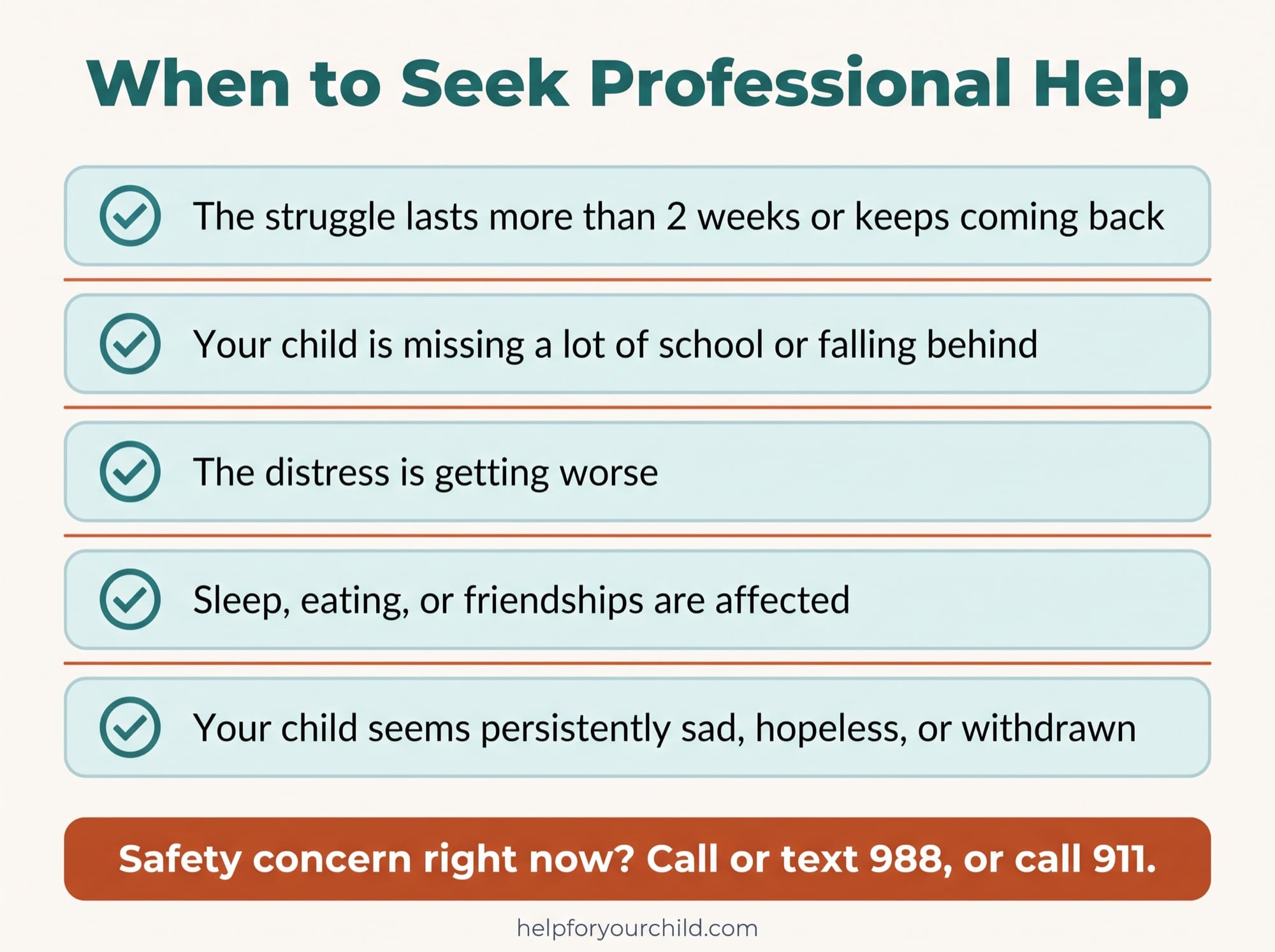
Call your pediatrician or a licensed mental health professional if:
- The struggle has lasted more than a couple of weeks or keeps coming back.
- Your child is missing a lot of school or falling behind.
- The distress is getting worse or spilling into sleep, eating, or friendships.
- Your child seems persistently sad, hopeless, or withdrawn.
A professional evaluation can sort out what's driving the behavior. An article can't do that, and neither can a checklist.
If you're worried about your child's safety right now, call or text 988 (the Suicide & Crisis Lifeline), or call 911.
You're Not Failing. You're Showing Up.
School refusal is hard on the whole family, and the fact you’ve read this far shows me you're not just sitting back and letting it happen. In summary, listen to your kiddo, notice the patterns, partner with the school, and get help early if things aren't improving. Most kids do make it back to the classroom, especially when the adults around them work as a team.
If you'd like help, that's exactly why we're here. To get started, please email us at [email protected], call (724) 850-7200, or visit helpforyourchild.com. We'd be honored to walk this road with you.
God bless you and your family.
— Dr. John Carosso, Psy.D.
Frequently Asked Questions
What should I do if my child refuses to go to school tomorrow morning?
Stay calm and keep the routine. Validate the feeling ("I know this is hard") while keeping the expectation that school happens. Offer a small first step, like getting to the front office, and let the school know. If this continues, please initiate the six-step plan outlined above.
Should I force my child with anxiety to go to school?
Don't drag or shout; that ramps up the panic. But don't make staying home easy either, since avoidance makes anxiety grow. Aim for warm and firm: a clear expectation, small steps, rewards for effort, and support from the school and, if needed, a therapist.
What age is school refusal most common?
It can happen at any age, but it peaks around ages 5 to 6 and 10 to 11. Those years line up with big transitions, like starting school and moving toward middle school. A new school or the jump to high school can trigger it, too.
Is school refusal the same as truancy?
No. Truancy usually means skipping school for something more fun, often without parents knowing. School refusal comes from distress, and the child usually wants to stay home with a parent. Even so, in Pennsylvania, anxiety-related absences can still count toward truancy if they're unexcused.
Is it school refusal if my child goes late or leaves early?
It can be. Late arrivals, early pickups, long stays in the nurse's office, and daily battles at the door are all part of the picture, even when your child technically gets there. Track the pattern and share it with the school.
What is the best treatment for school refusal?
Cognitive behavioral therapy (CBT) with gradual exposure has the strongest support. It teaches coping skills and helps your child face school in small, planned steps. Parent coaching, school accommodations, and sometimes medication can add to it.
What is the 3-3-3 rule for anxiety in children?
It's a quick grounding exercise. Your child names three things they can see and three things they can hear, then moves three parts of their body. It pulls attention away from racing worries and back to the present. Practice it on calm days first.
Sources
- Fremont, W. P. (2003). School refusal in children and adolescents. American Family Physician, 68(8), 1555–1561. aafp.org
- Di Vincenzo, C., et al. (2024). School refusal behavior in children and adolescents: A five-year narrative review of clinical significance and psychopathological profiles. Italian Journal of Pediatrics. PMC11141005
- Pennsylvania Department of Education. Compulsory school attendance, unlawful absences, and school attendance improvement conferences (Basic Education Circular). pa.gov
- Education Law Center–PA. Truancy and school attendance. elc-pa.org
- Attendance Works. Chronic absence: The problem. attendanceworks.org
- 988 Suicide & Crisis Lifeline. 988lifeline.org